
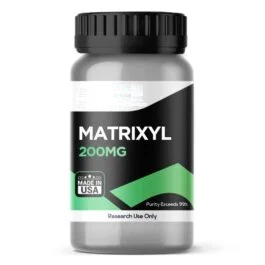
Matrixyl (200mg)

£160.00
Size: 10mg
Contents: Matrixyl (Palmitoyl Pentapeptide-4)
Form: Lyophilized Powder
Purity: >99%
SKU: P-MATRIXYL
FREE Shipping on £200+ orders
Matrixyl (Palmitoyl Pentapeptide-4) is a synthetic matrikine peptide widely studied for its role in collagen signalling, fibroblast activity, extracellular matrix regeneration, and skin structure research. Researchers commonly use it in anti-ageing, tissue remodelling, and dermal repair models.
Buy Matrixyl Peptide UK | Palmitoyl Pentapeptide-4
Buy Matrixyl Peptide UK, also known as Palmitoyl Pentapeptide-4, is a high-purity synthetic peptide supplied by Peptide House UK exclusively for laboratory research purposes. Researchers widely study this peptide because it acts as a matrikine, helping scientists investigate collagen signalling pathways and extracellular matrix activity.
Unlike many structural peptides, Matrixyl functions as a cellular messenger. Consequently, researchers use it to explore how fibroblasts respond to collagen fragments and how these signals influence tissue maintenance and regeneration.
Why Researchers Choose Matrixyl
Researchers frequently select Matrixyl because it offers a highly targeted approach to studying collagen production and skin structure dynamics. In addition, its palmitoyl group enhances stability and increases compatibility within lipid-rich research environments.
Furthermore, Matrixyl remains one of the most recognised peptides in skin biology research, making it an important compound for laboratories investigating extracellular matrix regulation.
- Collagen signalling research
- Fibroblast activity studies
- Extracellular matrix investigations
- Skin structure research
- Tissue remodelling models
- Anti-ageing peptide research
Mechanism of Action
Matrixyl is believed to function as a signalling peptide that communicates directly with fibroblasts. As a result, researchers investigate its influence on proteins responsible for maintaining tissue structure and integrity.
Specifically, studies focus on how Matrixyl may support the production of extracellular matrix components that contribute to skin architecture and tissue organisation.
- Collagen synthesis pathways
- Elastin production research
- Fibronectin regulation studies
- Laminin-related investigations
Therefore, Matrixyl continues to attract interest across cosmetic science, tissue engineering, and regenerative biology research fields.
Key Research Applications
1. Collagen Production Research
One of the primary reasons researchers buy Matrixyl is to study collagen-related signalling pathways. Research models suggest that Matrixyl may mimic natural collagen fragments and stimulate fibroblast communication.
Consequently, scientists use it to examine collagen production mechanisms and extracellular matrix maintenance processes.
- Collagen synthesis studies
- Fibroblast communication research
- Extracellular matrix signalling
- Tissue integrity investigations
2. Skin Texture & Anti-Ageing Research
Matrixyl is widely investigated in skin structure research. For example, researchers analyse its effects on skin texture, elasticity, and wrinkle-related pathways.
Additionally, multiple experimental models explore how Matrixyl influences structural proteins that contribute to skin appearance and resilience.
- Wrinkle research models
- Skin texture investigations
- Elasticity pathway studies
- Dermal structure analysis
3. Fibroblast & Scar Formation Studies
Researchers also study Matrixyl in models focused on fibroblast regulation and tissue remodelling. Furthermore, investigations examine how fibroblasts respond during scar formation and collagen deposition processes.
As a result, Matrixyl remains relevant in fibrosis-related and tissue remodelling research.
- Fibroblast activity analysis
- Scar formation research
- Fibrosis pathway investigations
- Collagen remodelling studies
4. Tissue Repair & Regeneration Research
Matrixyl is frequently explored in tissue repair models because researchers seek to understand how cellular signalling influences regeneration processes.
Moreover, studies investigate how extracellular matrix regulation contributes to tissue recovery and structural maintenance.
- Tissue regeneration research
- Dermal repair models
- Cell signalling investigations
- Recovery pathway studies
Chemical Profile
- Molecular Formula: C39H75N7O10
- Molecular Weight: 802.05 g/mol
- Alternative Names: Palmitoyl Pentapeptide-4, Palmitoyl Pentapeptide-3
Research Benefits of Matrixyl
- Well-established peptide in collagen research
- Strong relevance in extracellular matrix studies
- Supports fibroblast signalling investigations
- Widely used in anti-ageing peptide research
- Applicable across multiple skin biology models
- Useful in tissue remodelling studies
Related Research Peptide Categories
Researchers frequently combine Matrixyl studies with broader skin, collagen, and regenerative biology research programmes. Therefore, it is commonly associated with the following peptide categories.
- GHK-Cu Peptide
- Acetyl Hexapeptide-3 (Argireline)
- SNAP-8 Peptide
- Anti-Ageing & Skin Peptides
- Healing & Recovery Peptides
Why Buy From Peptide House UK?
- Premium research-grade peptides
- Strict quality assurance standards
- High-purity manufacturing processes
- Secure UK checkout and shipping
- Trusted UK peptide supplier
- Consistent batch-to-batch quality
Important Notice
Matrixyl (Palmitoyl Pentapeptide-4) is supplied strictly for laboratory and scientific research purposes only. It is not intended for human consumption, medical use, or diagnostic applications.
Peptide House UK supplies this peptide exclusively to support legitimate scientific and laboratory research activities.
Related products

Longevity & Cellular Health
Anti-Ageing Peptides UK
Longevity & Cellular Health
Anti-Ageing Peptides UK

Longevity & Cellular Health
Fat Loss & Metabolic Peptides
Longevity & Cellular Health

Anti-Ageing Peptides UK