
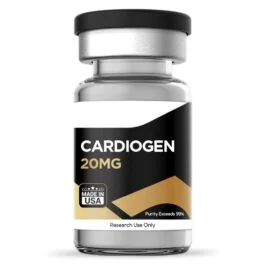
Cardiogen (20mg)

£71.25
Size: 10mg
Contents: Cardiogen
Form: Lyophilized powder
Purity: >99%
SKU: P-CARDIOGEN
FREE Shipping on £200+ orders (UK only)
Cardiogen is a synthetic tetrapeptide studied for fibroblast regulation and cardiovascular research models. Researchers actively investigate its role in tissue repair, cellular regeneration, apoptosis pathways, and structural protein expression.
Buy Cardiogen Peptide UK | Cardiovascular Research Tetrapeptide
Buy Cardiogen Peptide UK, a high-purity synthetic tetrapeptide supplied by Peptide House UK for laboratory research purposes only. Researchers actively study this compound because it plays a key role in fibroblast regulation, cellular repair processes, and cardiovascular tissue modelling.
Importantly, Cardiogen influences fibroblast activity, which makes it highly relevant in tissue regeneration research. As a result, scientists frequently use it in models that explore structural integrity, cellular ageing, and tissue remodelling processes.
Why Researchers Choose Cardiogen
Researchers choose Cardiogen because it provides a multi-pathway model for studying fibroblast-driven biological activity. In addition, it allows detailed investigation of how cells respond to injury, stress, and regenerative signalling.
Moreover, its dual biological behaviour makes it particularly valuable in both cardiovascular research and broader tissue engineering studies.
- Fibroblast activity regulation research
- Cardiovascular tissue modelling
- Cellular repair and regeneration studies
- Apoptosis signalling analysis
- Structural protein expression research
Mechanism of Action
Cardiogen modulates fibroblast behaviour in controlled laboratory models. Specifically, researchers examine how it influences cell differentiation, gene expression, and apoptosis-related signalling pathways.
Therefore, it is widely used in experimental systems that investigate tissue repair, cellular turnover, and cardiovascular remodelling processes.
- Fibroblast differentiation modulation
- Gene expression regulation in repair models
- Apoptosis pathway interaction studies
Key Research Applications
1. Cardiovascular & Tissue Repair Research
Researchers actively use Cardiogen in cardiovascular models because it may influence cardiomyocyte activity and fibroblast-driven tissue remodelling. For example, studies examine how it affects scar formation and structural protein expression.
In addition, it supports research into cellular organisation within damaged tissue environments, which improves understanding of repair mechanisms.
- Cardiomyocyte proliferation studies
- Fibroblast scar reduction models
- Cardiac tissue remodelling research
2. Cellular Protection & Apoptosis Modulation
Researchers frequently study Cardiogen in apoptosis regulation models. In particular, they analyse its interaction with the p53 signalling pathway, which plays a central role in programmed cell death.
Consequently, Cardiogen demonstrates cell-type-specific behaviour depending on the biological environment under study.
- Cell survival pathway research
- Apoptosis regulation in cardiac models
- p53 signalling pathway studies
3. Cancer & Cell Growth Research Models
In oncology research, Cardiogen is explored for its ability to influence abnormal cell growth pathways. For instance, researchers examine how it affects vascular signalling and tumour microenvironment dynamics.
Furthermore, it is not considered a cytotoxic agent; instead, it is studied as a signalling-modulating compound in controlled laboratory environments.
- Tumour signalling pathway analysis
- Cell proliferation regulation studies
- Vascular structure research models
4. Structural Protein & Fibroblast Research
Cardiogen is also studied in fibroblast cultures to understand how it influences structural protein expression. As a result, researchers observe changes in actin, tubulin, and nuclear protein activity.
In addition, these changes help scientists better understand cellular organisation and metabolic activity.
- Structural protein expression studies
- Cellular organisation research
- Fibroblast metabolism models
5. Cellular Ageing & Senescence Research
In ageing models, Cardiogen is used to study fibroblast senescence and cellular decline. Moreover, researchers investigate its potential role in restoring signalling activity in aged cell systems.
- Senescent fibroblast research
- Cellular ageing pathway analysis
- Differentiation marker studies
Chemical Profile
- Molecular Formula: C18H31N7O9
- Molecular Weight: 489.5 g/mol
- Structure: H-Ala-Glu-Asp-Arg-OH
- Alternative ID: SCHEMBL3194515
Cardiovascular Research Cluster
- Thymosin Beta-4
- Cardiovascular Peptides
- Cardiac Repair Peptides Guide
Fibroblast & Tissue Repair Cluster
Cellular Ageing Cluster
Why Buy from Peptide House UK?
- Premium research-grade peptide sourcing
- Strict laboratory quality control standards
- High-purity verified compounds
- Secure UK shipping & checkout
- Trusted UK peptide supplier
Important Notice
Cardiogen is supplied strictly for laboratory research purposes only. It is not intended for human consumption, medical use, or diagnostic applications.
At Peptide House UK, we maintain strict compliance standards to ensure all products are suitable for controlled scientific research environments.
Related products
Healing & Recovery Peptides
Anti-Ageing Peptides UK

Healing & Recovery Peptides

Healing & Recovery Peptides
Healing & Recovery Peptides
Healing & Recovery Peptides
Healing & Recovery Peptides
Healing & Recovery Peptides