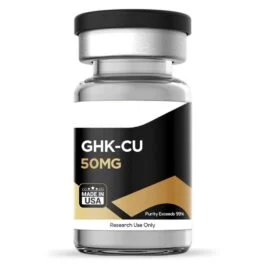
GHK-Cu (Copper) (50mg)
£55.10
Size: 50mg
Contents: GHK-Cu (Copper Peptide)
Form: Lyophilized powder
Purity: >99%
SKU: P-GHKCU
FREE Shipping on £200+ orders (UK only)
GHK-Cu is a naturally occurring copper-binding peptide widely studied in research involving collagen production, skin structure, tissue regeneration, cellular repair pathways, and hair follicle biology. Researchers frequently investigate its role in gene expression, antioxidant activity, and regenerative signalling.
Buy GHK-Cu Copper Peptide UK | High-Purity Research Peptide
Buy GHK-Cu Copper Peptide UK, a naturally occurring copper-binding tripeptide composed of glycine, histidine, and lysine. At Peptide House UK, we supply high-purity GHK-Cu exclusively for laboratory research applications. Researchers widely investigate this peptide because of its involvement in tissue regeneration, skin structure, cellular communication, and gene expression pathways.
Importantly, GHK-Cu occurs naturally within the human body and plays a role in biological responses to tissue stress and repair. However, natural levels decline with age. Consequently, researchers continue exploring its significance across regenerative biology, dermatological research, and cellular health studies.
Why Researchers Choose GHK-Cu
Researchers frequently select GHK-Cu because it combines copper-binding activity with broad biological relevance. In addition, its involvement in multiple cellular pathways makes it one of the most extensively studied peptides within skin and regenerative research.
Furthermore, GHK-Cu is commonly investigated in models focused on collagen production, wound healing, tissue remodelling, and cellular resilience.
- Collagen and extracellular matrix research
- Skin structure and elasticity studies
- Tissue repair and regeneration models
- Gene expression investigations
- Hair follicle and growth research
- Oxidative stress pathway studies
Mechanism of Action
GHK-Cu functions as a copper-binding peptide complex that participates in cellular signalling processes. Researchers study how it influences communication pathways involved in tissue maintenance, regeneration, and structural integrity.
Moreover, studies suggest that GHK-Cu may affect genes associated with repair mechanisms, extracellular matrix organisation, and cellular recovery. Therefore, it remains a significant focus within regenerative research environments.
- Cellular signalling pathway research
- Gene regulation studies
- Extracellular matrix investigations
- Tissue remodelling models
Key Research Applications
1. Collagen & Skin Structure Research
Researchers widely study GHK-Cu for its potential relationship with collagen synthesis and extracellular matrix maintenance. As a result, it is frequently included in skin biology and cosmetic peptide research.
Additionally, studies investigate its role in tissue density, skin elasticity, and structural organisation within dermal models.
- Collagen production research
- Skin elasticity studies
- Dermal structure investigations
- Extracellular matrix analysis
2. Tissue Repair & Regeneration Studies
GHK-Cu is one of the most researched peptides within regenerative biology. Researchers examine how it influences tissue recovery processes and cellular repair mechanisms following injury-related stress.
Furthermore, many studies explore its involvement in protein synthesis, tissue remodelling, and recovery-related signalling pathways.
- Tissue regeneration research
- Cellular repair pathway studies
- Protein synthesis investigations
- Recovery biology models
3. Gene Expression & Cellular Function
One of the most compelling areas of GHK-Cu research involves gene activity. Researchers continue investigating how this peptide influences genes associated with repair, regeneration, and inflammatory regulation.
Consequently, GHK-Cu remains highly relevant in studies focused on cellular adaptation and biological resilience.
- Gene expression research
- Cellular adaptation studies
- Regenerative signalling investigations
- Inflammatory pathway analysis
4. Antioxidant & Cellular Resilience Research
Researchers also investigate GHK-Cu for its interaction with oxidative stress pathways. Specifically, studies explore its relationship with reactive oxygen species and cellular defence mechanisms.
Therefore, it is frequently used in experimental models examining cellular resilience and age-related biological changes.
- Oxidative stress research
- Reactive oxygen species studies
- Cellular resilience models
- Age-related biology investigations
5. Hair Follicle & Growth Research
Emerging research suggests GHK-Cu may influence signalling pathways involved in hair follicle activity and tissue regeneration. As a result, researchers continue exploring its role within hair biology and follicular development studies.
- Hair follicle research
- Tissue growth investigations
- Cellular signalling studies
- Regeneration pathway analysis
Chemical Profile
- Molecular Formula: C14H23CuN6O4
- Molecular Weight: 340.38 g/mol
- Alternative Name: Glycyl-L-histidyl-L-lysine Copper (II)
Related Research Peptide Clusters
Anti-Ageing & Skin Peptides
Recovery & Regeneration Cluster
Longevity & Cellular Health Cluster
Why Buy from Peptide House UK?
- Premium research-grade peptides
- Strict quality control standards
- High-purity manufacturing processes
- Secure UK shipping and checkout
- Trusted UK peptide supplier
- Consistent batch-to-batch quality
Important Notice
GHK-Cu is supplied strictly for laboratory and scientific research purposes only. It is not intended for human consumption, medical use, or diagnostic applications.
Peptide House UK supplies research compounds exclusively for qualified laboratory use and scientific investigation.
Related products
Anti-Ageing Peptides UK
Anti-Ageing Peptides UK
Anti-Ageing Peptides UK
Anti-Ageing Peptides UK
Anti-Ageing Peptides UK
Longevity & Cellular Health
Anti-Ageing Peptides UK
Anti-Ageing Peptides UK